
12 Most Asked Questions About Prop Trading & Funded Accounts in 2026
Proprietary trading, or prop trading, has become one of the fastest-growing ways for traders to access capital and trade professionally. Many traders, especially newcomers, have questions about how funded accounts work, what evaluation challenges entail, and how to follow risk rules.
In this post, we answer the 12 most frequently asked questions about prop trading and funded accounts in 2026, based on commonly searched queries and verified sources.
12 Most Frequently Asked Questions
1. What is a prop trading firm?
A prop trading firm (proprietary trading firm) provides traders with capital to trade financial markets after they pass an evaluation. The firm risks its own capital and typically shares profits with traders.
2. How do funded accounts work?
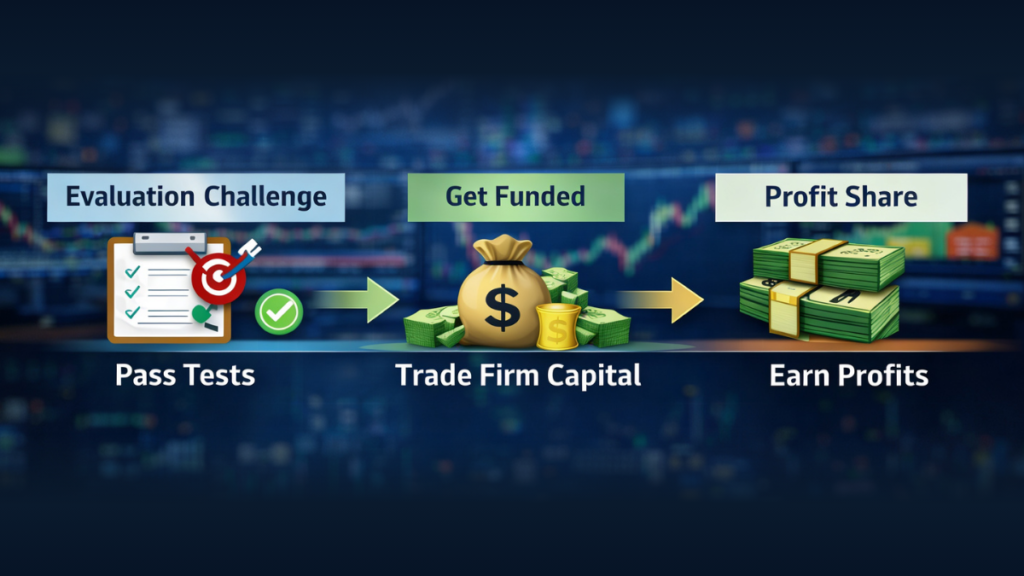
Funded accounts require traders to:
- Pass an evaluation challenge with profit and risk requirements
- Demonstrate consistency over a set period or number of trades
- Trade firm capital under ongoing risk rules
Traders then earn a share of profits while adhering to strict trading guidelines.
3. What are typical evaluation requirements?
Common evaluation criteria include:
- Profit targets within a specific time frame
- Maximum drawdown limits (daily and overall)
- Minimum number of trading days or trades
- Consistent risk‑aware trading behavior
These rules ensure traders can manage capital responsibly.
4. Do prop firms require fees to join?
Yes. Most prop firms charge an evaluation or challenge fee to participate. Fees vary by account size and challenge type. Some firms refund part or all of the fee after successful completion of the evaluation.
5. Can I trade any style or strategy?
Most prop firms allow multiple trading styles — scalping, swing trading, or intraday — as long as risk rules are followed. Certain restrictions may apply for overnight positions or highly leveraged trades.
6. What markets can funded traders access?
Funded accounts often allow trading in:
- Currencies
- Indices
- Commodities
- Cryptocurrencies
Available instruments depend on the firm and trading platform.
7. How does profit sharing work?
Once a trader is funded, profits are typically split according to a pre-agreed ratio (e.g., 70/30 or 80/20). Payouts are usually made monthly or bi-weekly, depending on firm policy.
8. What happens if I fail an evaluation?
If a trader does not meet the evaluation rules, the challenge ends. Some firms allow traders to restart evaluations, sometimes with discounted fees or under revised conditions.
9. Are online prop firms legitimate?
Many online prop trading firms are legitimate businesses with structured evaluations and documented payouts. Traders should verify transparency, rules, and payout history before joining.
10. Do I need prior experience to start prop trading?
While formal experience isn’t always required, traders benefit from:
- Consistent personal trading experience
- Strong risk management habits
- Familiarity with evaluation rules
Unprepared traders risk multiple evaluation failures.
11. What’s the difference between prop firms and brokers?
- Prop Firms: Provide firm capital for trading after evaluation; profits are shared.
- Brokers: Allow trading with personal capital; all profits and losses belong to the trader.
12. Can I trade funded accounts and personal accounts at the same time?
Yes. Most firms allow traders to manage multiple accounts as long as rules are followed in each account. Maintaining consistent risk management is key.
Conclusion
Prop trading and funded accounts continue to attract traders seeking professional capital access in 2026. By understanding evaluation requirements, risk rules, profit sharing, and trading guidelines, traders can make informed decisions and prepare for challenges.
At Centrino Trader, transparency, structured evaluation, and clear risk management rules help traders navigate funded accounts confidently.
Disclaimer:
The information and data presented in this content are based on sources that we believe to be authentic and reliable. While efforts are made to ensure accuracy, Centrino Trader does not guarantee the completeness or timeliness of this information. The content is not financial, investment, or legal advice and should not be considered a recommendation. Trading in financial markets, including proprietary trading, carries significant risk, and past data or performance does not guarantee future outcomes. Readers are encouraged to verify details independently before making any trading or investment decisions. T&C apply*.