
Risk Management Rules Traders Must Master in Funded Accounts
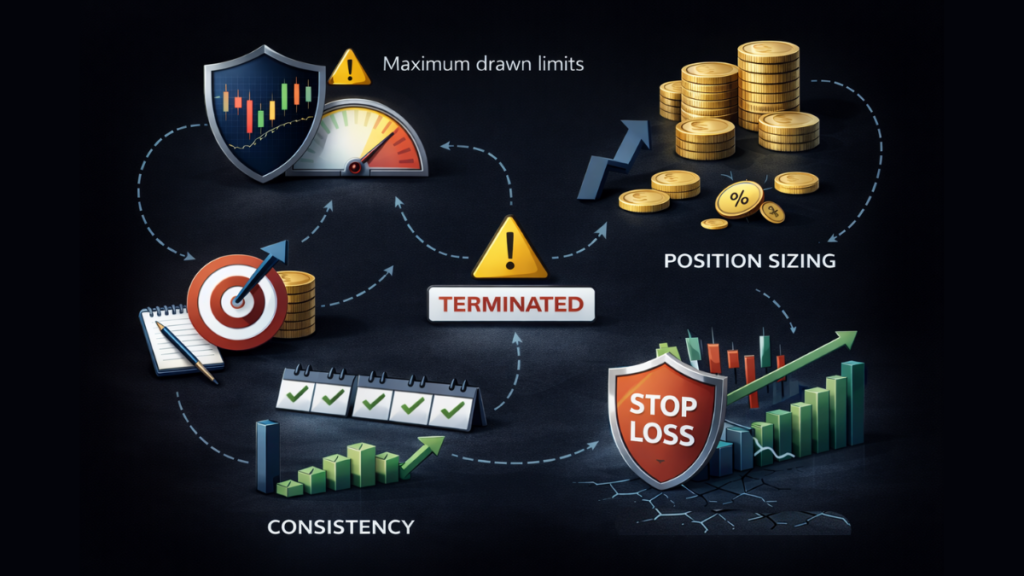
Risk management is the cornerstone of successful prop trading. Funded accounts operate under strict rules to protect capital, so understanding and adhering to these rules is critical for any trader.
In this post, we explore the key risk management rules, explain why they matter, and highlight common patterns of success and failure among funded account traders.
Why Risk Management Matters in Funded Accounts
Unlike personal trading accounts, funded accounts have predefined risk limits that traders must follow. Failure to comply with these rules can result in:
- Immediate account termination
- Loss of access to capital
- Failure to complete evaluation challenges
Understanding these rules is not optional — it’s essential for navigating funded accounts safely and professionally.
Key Risk Management Rules for Funded Traders
1. Maximum Drawdown Limits
Most prop firms set strict drawdown limits — often a percentage of total capital.
- Daily drawdown: Limits on losses within a single day.
- Overall drawdown: Maximum cumulative loss allowed before account closure.
Why it matters: Staying within drawdown limits ensures longevity and demonstrates discipline. Violating limits is one of the most common causes of funded account failure.
2. Position Sizing & Risk Per Trade
Traders should never risk too much capital on a single trade. Typical rules include:
- Risking 1–2% of total capital per trade
- Adjusting trade size according to market volatility
Why it matters: Small, consistent risks prevent catastrophic losses and allow traders to survive losing streaks.
3. Daily Trade Limits
Some prop firms impose limits on the number of trades per day or per instrument.
Why it matters: Overtrading can lead to impulsive decisions, violating discipline and increasing the chance of hitting drawdown limits.
4. Consistency & Minimum Trading Periods
Many funded accounts require traders to demonstrate consistent trading over multiple days or weeks rather than one-time profits.
Why it matters: Consistency is a stronger predictor of long-term account adherence than single high-profit trades.
5. Stop-Loss Discipline
Always using stop-loss orders is a fundamental rule. Ignoring them is a common cause of risk management failure.
Why it matters: Stop-losses prevent large unexpected losses and enforce discipline, aligning with firm risk protocols.
Success and Failure Patterns in Funded Accounts
| Pattern | Outcome |
|---|---|
| Strict adherence to drawdowns & risk per trade | Higher evaluation completion and longer account longevity |
| Overtrading or ignoring rules | Frequent violations, account termination, failure in evaluations |
| Consistent, disciplined trading | Better risk-adjusted performance, easier scaling to larger accounts |
| Impulsive, emotionally driven trades | Increased loss rates, hitting drawdown limits quickly |
These patterns are consistently observed in prop trading communities and evaluations. The common theme: discipline and rule adherence matter more than individual trade outcomes.
Tips for Effective Risk Management
1. Plan trades in advance: Have a strategy that defines entries, exits, and risk.
2. Track all trades: Maintain a trading journal to review rule compliance.
3. Use analytics tools: Monitor drawdowns, risk per trade, and consistency metrics.
4. Respect evaluation rules: Every funded account has specific guidelines — know them and follow them precisely.
5. Avoid emotional trading: Stick to your plan, even during winning or losing streaks.
Conclusion
Mastering risk management is non-negotiable for funded account traders. Success and failure are closely linked to how well traders adhere to drawdown limits, position sizing, stop-loss rules, and consistency requirements.
Frequently Asked Questions (FAQs)
1. What is the most common reason traders fail funded accounts?
Exceeding drawdown limits and ignoring risk rules are the leading causes of failure.
2. Are stop-losses mandatory in funded accounts?
Yes, stop-losses are essential for complying with risk limits and protecting capital.
3. How important is trade consistency?
Consistency over time is more important than isolated profitable trades; firms evaluate disciplined, repeatable strategies.
4. Can analytics tools help with risk management?
Yes, tracking drawdowns, trade sizes, and performance metrics helps traders stay compliant with rules and avoid mistakes.
Disclaimer:
The information and data presented in this content are based on sources that we believe to be authentic and reliable. While efforts are made to ensure accuracy, Centrino Trader does not guarantee the completeness or timeliness of this information. The content is not financial, investment, or legal advice and should not be considered a recommendation. Trading in financial markets, including proprietary trading, carries significant risk, and past data or performance does not guarantee future outcomes. Readers are encouraged to verify details independently before making any trading or investment decisions. T&C apply*.